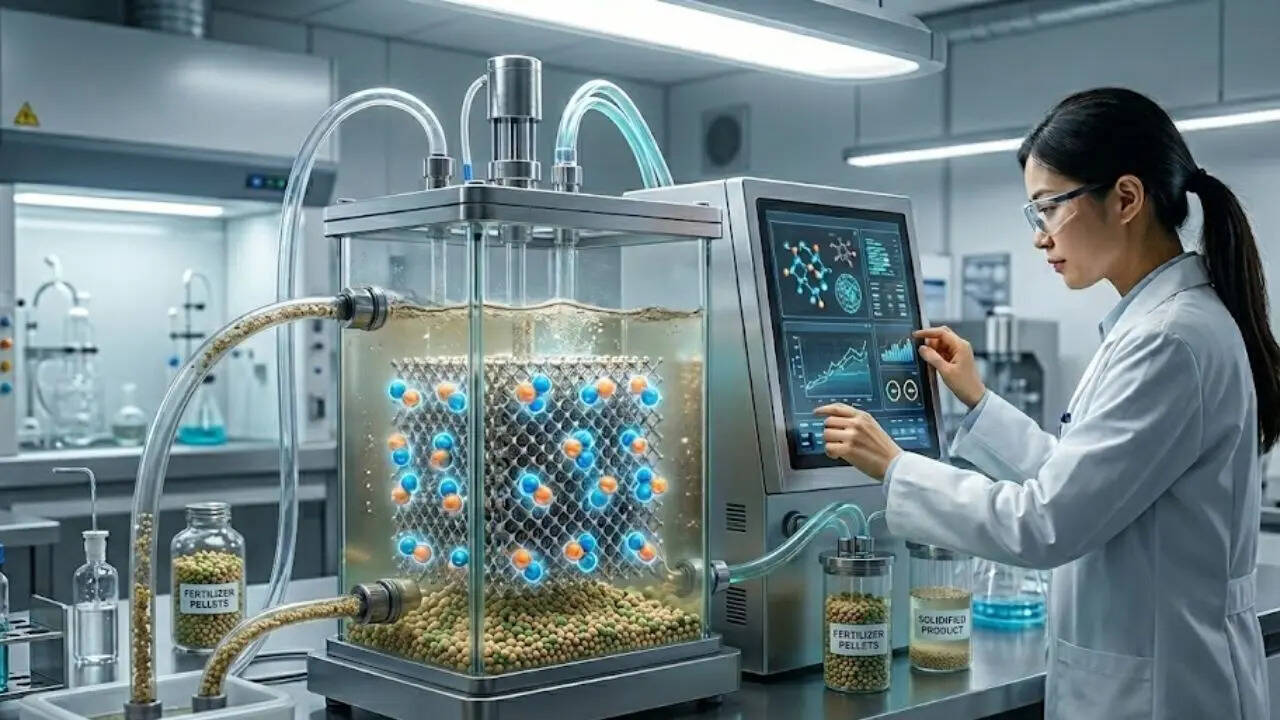
The Times Of India reports: PC: Google Gemini Chinese researchers have made a significant advancement in circular resource recovery by creating a new way to turn nitrate-laden wastewater into valuable ammonia for fertilisers. They used artificial intelligence to find a super-effective dual-atom catalyst, which led them to a process that tackles two major global issues: water pollution and the heavy energy use of traditional industrial ammonia production. Their findings, published in the Journal of the American Chemical Society, show that this method achieves almost three times the conversion efficiency of earlier technologies.
By converting runoff from farms and factories, this approach provides an eco-friendly solution to lessen environmental ‘dead zones’ and cuts down on the agricultural sector's dependence on energy-heavy chemical methods. This AI-driven breakthrough bridges the gap between environmental remediation and industrial innovation, paving the way for a truly circular economy.This new Chinese AI breakthrough could turn sewage water into fertiliser for cropsThis breakthrough lies in leveraging machine learning to discover the optimal atomic coordination for nitrate electroreduction. Researchers pinpointed a ‘dual-atom catalyst’ (DAC) that acts like a synergistic active site, working together seamlessly.
Background
As noted in the Journal of the American Chemical Society, this AI-optimised structure allows for the rapid conversion of nitrates - often found in high concentrations in agricultural runoff - directly into ammonia. Unlike the Haber-Bosch method from over a century ago, which demands extreme heat and pressure, this electrochemical process works at room temperature. This approach dramatically reduces the energy needed for making fertilisers.Solving the mystery of aquatic ‘dead zones’Nitrate pollution plays a big role in causing eutrophication, which is when too many nutrients create ‘dead zones’ without oxygen in oceans and lakes, harming aquatic life.
Key facts
- Their findings, published in the Journal of the American Chemical Society, show that this method achieves almost three times the conversion efficiency of earlier technologies.
- Researchers pinpointed a ‘dual-atom catalyst’ (DAC) that acts like a synergistic active site, working together seamlessly.
- Unlike the Haber-Bosch method from over a century ago, which demands extreme heat and pressure, this electrochemical process works at room temperature.
What this means
Usually, wastewater treatment involves nitrogen removal by converting it into a gas that goes back into the atmosphere. However, there's a new approach, Nitrogen harvesting, which stops it from entering the environment and also provides nutrients for local farms. The United States Environmental Protection Agency (EPA) says dealing with nitrogen and phosphorus is one of the toughest environmental challenges for modern water systems.How green ammonia can lower global carbon footprintsRight now, ammonia synthesis around the world causes about 1.4 per cent of all carbon dioxide emissions and uses roughly 2 per cent of the planet's energy.
The Haber-Bosch process counts on natural gas for the hydrogen it needs to combine with nitrogen. But there’s a different approach from a Chinese research team - getting nitrogen straight from wastewater using renewable electricity. This offers a more eco-friendly option that might greatly cut down the carbon impact in global food production.
Originally reported by The Times Of India. This story has been edited and re-presented by BRIC Team.