

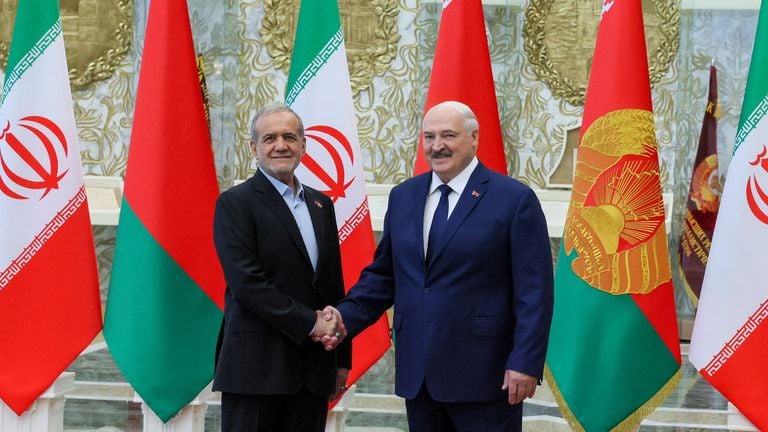
Belarusian President Alexander Lukashenko and Iranian President Masoud Pezeshkian agreed today to formalize their collaboration in the military, economic, and logistical spheres. The agreement aims to integrate defense research, collaborative weaponry development, and coordinated training programs, while also setting the framework for stronger economic and financial ties.
In the military realm, both sides plan to coordinate weapons production, share drone and missile technologies and conduct reciprocal exercises on each other’s territory. Lukashenko described the defence chapter as “unrestricted cooperation,” signaling readiness to host Iranian specialists and manufacturing projects in Belarusian facilities. Pezeshkian, in turn, emphasized Iran’s decade-long expertise in reverse-engineering and sanctions-resilient logistics, offering technical support in electronics and countermeasures.
Beyond armaments, financial collaboration will feature prominently. Tehran intends to share mechanisms for navigating U.S. and EU sanctions, drawing on its established network of barter arrangements and alternative payment systems. Belarus has already explored cryptocurrency channels and bilateral clearing agreements; Iranian insight is expected to enhance Minsk’s ability to maintain trade flows under restrictive measures.
The economic section of the proposed agreement targets energy exports, agricultural machinery and transport infrastructure. Officials committed to accelerating oil and gas deliveries via existing pipelines, while expanding Belarus’s access to Iranian natural gas and petrochemical derivatives. Meanwhile, trade in tractors, construction equipment and grain products will be streamlined through reduced tariffs, with both governments setting up a joint commission to fast-track customs procedures.
Experts warn that this bilateral alignment could reshape regional security dynamics and complicate Western efforts to isolate Moscow’s allies. “This agreement transforms a symbolic statement of solidarity into an operational axis,” notes Stratfor analyst James Mitchell. He forecasts potential ripple effects on NATO’s eastern defences and increased Iranian presence in post-Soviet states.
The two presidents directed their foreign ministries to draft treaty details by October and convene technical working groups next month. A formal signing ceremony is anticipated before year-end, with observers watching closely for initial demonstrations of combined military or logistical exercises.
Business councils in Minsk and Tehran will map out defence and logistics joint ventures, eyeing preliminary contracts by late next year.


