

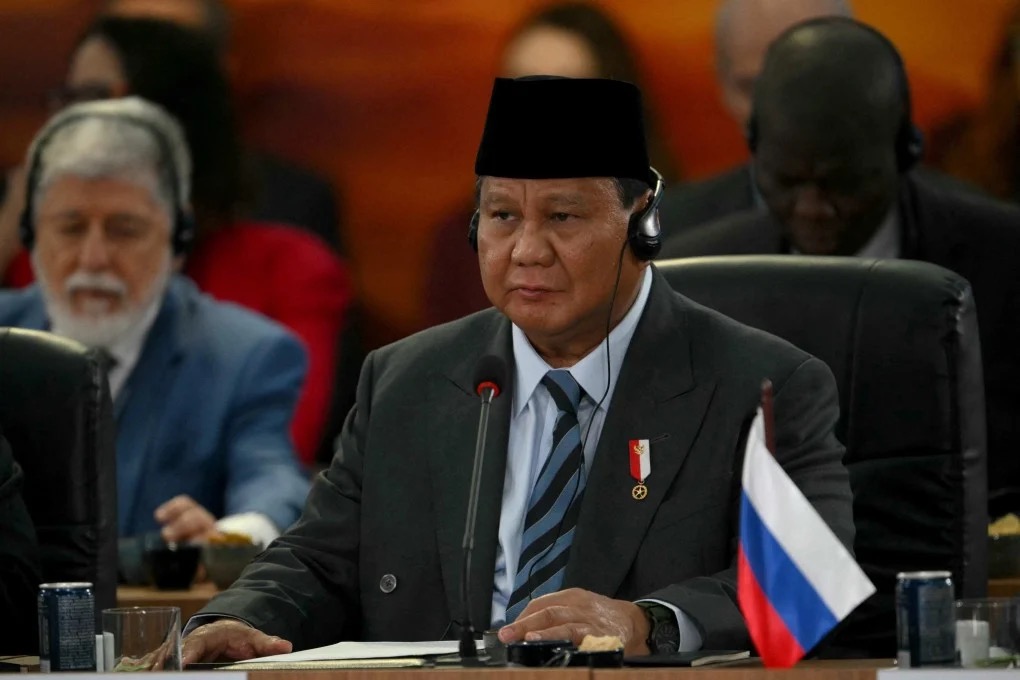
At the recent Brics summit in Rio de Janeiro, the global balance of power seemed to tilt ever so slightly. Emerging economies, led by countries like China, India, Brazil, Russia and South Africa, now joined by newer members including Indonesia, sent a message of resistance against what they described as unfair and unilateral policies dominating the global system.
For Indonesia, this summit was not just another diplomatic gathering. It was a declaration of intent. As the country fully joined the Brics group, it signaled its desire to play a more assertive role in shaping a multipolar world. But even before the applause faded, Jakarta found itself staring down a storm from Washington.
United States President Donald Trump, who has returned to the global stage with his signature brand of aggressive nationalism, wasted no time in sending a warning. On his social media platform, he announced that any country aligning with what he called anti-American Brics policies would face an extra ten percent tariff. For Indonesia, the threat was even more direct. Trump sent a letter to President Prabowo Subianto, stating that unless Indonesia reconsidered its economic and diplomatic direction, all Indonesian exports to the United States would be hit with a massive thirty two percent tariff starting August 1.
Trump justified the measure by pointing to the trade deficit between the two nations. He also added a condition — if Indonesia was willing to shift some of its manufacturing operations to American soil, the tariffs could be lifted. It was a transactional offer, but one laced with coercion.
This puts Indonesia in a precarious position. On the one hand, the country has long stood for a foreign policy of balance and non-alignment. On the other, its growing economic ties with the United States are real and valuable. Chevron’s renewed interest in Indonesia’s oil and gas sector is just one example of how American firms still see the country as a viable investment destination. But if Washington weaponises trade to punish strategic decisions, it risks transforming commerce into a tool of control.
Indonesia is not the only country under such pressure. Across the Global South, nations are watching closely. Many share Jakarta’s aspiration to move away from dependency on Western-led institutions and towards a world where smaller and medium sized states can assert themselves without becoming pawns in a larger game.
Brics represents that aspiration. With its own development bank, plans for an alternative payment system independent of the Western financial structure, and growing cooperation across sectors, the group is no longer symbolic. It is building economic infrastructure meant to rival the dominance of platforms like the International Monetary Fund and the World Bank. The Brics model is still evolving, but it offers a vision many developing countries find attractive — a world order not dictated by a few powerful capitals.
This is likely why Trump is so determined to undermine it. His strategy is to tie trade benefits to political loyalty. This may work in the short term, but it risks setting a precedent that any country pursuing independent partnerships could face economic punishment. It is a dangerous shift in global diplomacy.
Jakarta now has a difficult decision to make. Abandoning its alignment with Brics to preserve short term trade advantages would send a message that the United States can veto foreign policy choices by threatening tariffs. On the other hand, standing firm could lead to immediate economic hardship, especially for export driven industries that rely on access to the American market.
Yet Indonesia has been here before, navigating a world of competing interests. Its long standing foreign policy principle of independent and active diplomacy is rooted in a history of avoiding entanglement in great power rivalry. But the rules have changed. Now, neutrality is not enough. Choosing a future means inviting consequences.
Despite the pressure, Indonesia should remain committed to the path it has chosen. The promise of Brics lies not only in its potential to counterbalance Western dominance, but also in its commitment to reforming the global system in a way that reflects modern realities. In a world where new economic centers are rising and old powers are clinging to control, efforts to build pluralism should not be abandoned easily.
The risks are real. A sharp rise in tariffs could damage sectors like textiles, palm oil, and electronics. It may also trigger currency fluctuations or investor concerns. But the cost of retreating from strategic autonomy could be even greater. Once a country surrenders its policy space under pressure, regaining it becomes much harder.
This is not just Indonesia’s fight. It is part of a broader battle over how global governance will look in the next century. Will it be a system that punishes countries for acting independently, or one that supports cooperation across different interests and regions?
If Trump escalates this tariff agenda, it could deepen divisions between the Global North and South. Trust in existing trade norms will erode. More countries may begin building parallel institutions, seeking resilience rather than dependence. In the long run, this may isolate the very powers trying to maintain control through threats.
Indonesia could take this moment to lead by example. By opening dialogue, coordinating with fellow Brics members, and engaging in direct communication with Washington, Jakarta can still seek a resolution without abandoning its broader goals. Diplomacy may not always yield fast results, but it can prevent decisions made in haste and fear.
A world divided into hard blocs benefits no one. The promise of a multipolar system is not just more voices at the table — it is a chance to build fairness into global rules that have long served a narrow few. Indonesia, with its growing economy, strategic location, and diplomatic credibility, has the potential to champion that vision.
As the global system shifts, this moment offers a test. Not only of Indonesia’s resolve, but of the international community’s willingness to accept a future where emerging powers help write the rules — not just follow them.


